
Loading...
Serving Sparks, NV and surrounding areas. (775) 510-0154
Your building runs its HVAC harder than it should every summer and winter. Better insulation reduces what you spend on energy, keeps employees comfortable, and meets Nevada's commercial energy code from day one.
Commercial insulation in Sparks slows heat transfer through a building's roof, walls, and floors so the HVAC system can maintain comfortable temperatures without running constantly. Most mid-size commercial projects, such as adding or replacing insulation in an office or warehouse ceiling, are completed in one to three days with the business open and operating.
Sparks experienced significant commercial development from the 1970s through the 1990s, and many of those buildings were constructed to energy standards that are now considered inadequate. The combination of hot summers that regularly exceed 100 degrees and winters that drop below 20 degrees at night means those buildings are running their HVAC hard in both directions. An upgrade to current Nevada commercial energy code performance is not just a code requirement: it is the difference between a building that is expensive to operate and one that is not.
Business owners sometimes pair commercial insulation with spray foam insulation for continuous air sealing, or combine it with wall insulation upgrades in the same project scope.
If your cooling costs jump sharply from June through September and your HVAC seems to run almost constantly, that is a strong sign your building is not holding conditioned air. A well-insulated commercial building in Sparks's climate should be able to maintain comfortable temperatures without the system running nonstop. Unusually high summer utility bills are one of the clearest indicators that insulation is underperforming.
If employees in one section of the office are always too hot while another feels fine, the problem is often uneven or missing insulation rather than an HVAC issue. In older Sparks commercial buildings, insulation was sometimes installed inconsistently, or skipped in certain sections. Uneven temperatures are something you can feel and observe without any equipment.
If you can feel a draft near an exterior wall on a windy day, or if you notice dust streaks along the tops of interior walls, conditioned air is escaping and outside air is getting in. In Sparks's dry climate, building materials shift over time, and small gaps open up around wall penetrations and roof edges. These are visible, physical signs the building envelope has gaps.
Commercial buildings constructed in Sparks before the mid-1990s were built to energy standards that have since been significantly updated. If the original insulation has never been replaced or supplemented, it has likely settled, compressed, or degraded. Age alone is not a guarantee of a problem, but it is a strong reason to have the building evaluated before writing off high utility costs as unavoidable.
Commercial buildings in Sparks typically need insulation addressed in three zones: the roof or ceiling assembly, the exterior walls, and in some cases mechanical rooms or floors over unconditioned spaces. The right approach for each zone depends on the building type, the current insulation condition, and whether the project is new construction or a retrofit. Blown-in loose fill is the most common choice for adding insulation to existing ceiling cavities above drop tiles or attic spaces, because it is fast, fills irregular shapes completely, and does not require major demolition.
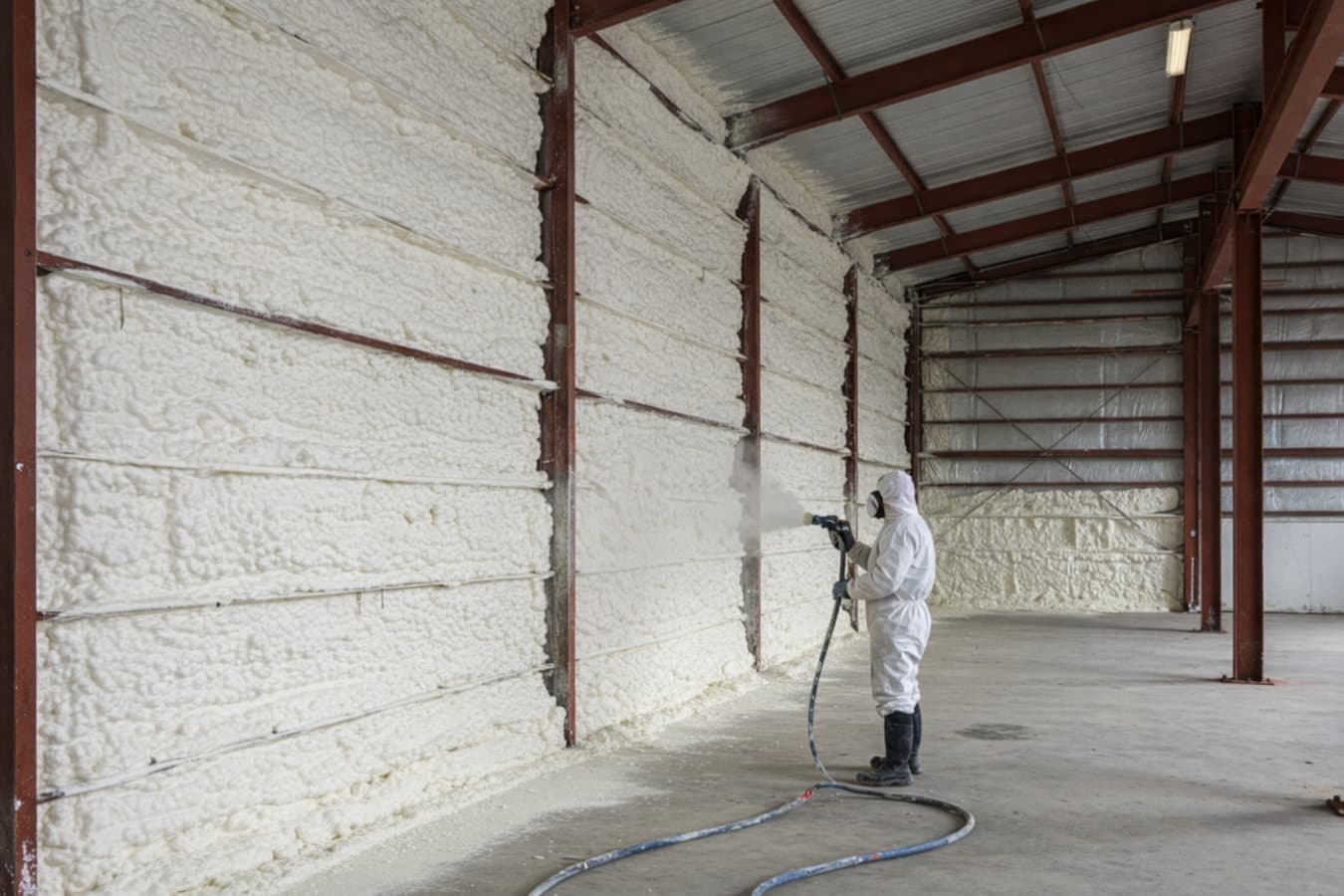
For walls that need to be addressed without gutting the interior, spray foam insulation applied to the interior surface of exterior walls provides both insulation and a continuous air barrier in a single step. This approach is particularly effective for warehouse-type buildings where the exterior wall structure is accessible from the inside. Rigid foam board is a third option for below-roof decking applications, where it provides high R-value without taking up floor-to-ceiling height.
Every commercial project in Sparks that requires a permit receives a detailed written scope before work begins, and we handle the Washoe County permit application on your behalf. The county inspection process, while it adds a step to the timeline, provides independent confirmation that the installation meets local energy code. The North American Insulation Manufacturers Association publishes installation guidelines that define what code-compliant commercial work looks like. Combining insulation with wall insulation upgrades in a single project scope often reduces total permit and scheduling overhead.
Best for commercial buildings where most of the thermal loss is happening through the top of the structure, which is typical of single-story offices and warehouses.
Suited for older Sparks buildings where exterior walls have minimal or degraded insulation and employees report persistent temperature complaints.
For developers and contractors building in the Reno-Sparks area who need code-compliant installation with permit documentation from day one.
Sparks sits in Climate Zone 5, a high desert environment that swings between 100-degree summers and sub-freezing winter nights. That is roughly an 80-degree seasonal temperature range that your building's insulation has to handle in both directions. Nevada's commercial energy code sets minimum performance requirements based on this climate zone, and those requirements are higher than what is needed in warmer parts of the state. A contractor who does not know the local climate zone may under-insulate your building and leave you with years of higher energy costs than you should be paying.
The dry desert air in Sparks also creates a specific challenge: building materials shrink and shift more in low-humidity climates than they do in wetter regions. Over time, small gaps open around insulation edges, wall penetrations, and roof connections, and conditioned air quietly escapes through them. Pairing insulation with careful air sealing is more important here than it would be in a humid climate where materials swell and naturally close small gaps.
Business owners operating in Sparks and nearby commercial corridors in Reno and Carson City face the same climate challenges. Buildings in all three areas fall in the same climate zone and are subject to the same commercial energy code performance standards.
We ask a few basic questions: building type and size, what is prompting the call, and whether any prior insulation work has been done. This helps us arrive at the site visit prepared. Expect a reply within one business day and an assessment visit scheduled within a few days to a week.
We walk through your building, check the roof or attic space, wall cavities, and any other zones where insulation is relevant, and measure what is already there. After the visit, you receive a written estimate that explains what is being recommended and why, not just a total cost.
For commercial projects in Sparks, we submit the permit application to Washoe County's Building and Safety Division before work begins. Permit approval typically takes a few days to a couple of weeks depending on project scope. We give you a realistic start date window, not a vague estimate.
The crew works in attic spaces, above drop ceilings, or in wall cavities, areas your employees and customers typically do not use. For permitted work, a county inspector visits before any surfaces are closed up. After the inspection passes, we walk you through what was installed and leave you with the documentation you need.
We provide free on-site estimates and handle the Washoe County permit process from start to finish. No phone guesses, no surprises on installation day.
(775) 510-0154We install insulation in offices, warehouses, and retail buildings across the Sparks area, so we know how commercial projects are sequenced and inspected. We document the finished work and put the full scope in writing before we start, and we coordinate the Washoe County permit so the paperwork is handled for you.
Nevada's commercial energy code sets minimum insulation performance levels for Sparks's climate zone that are higher than warmer parts of the state. We design every project to meet or exceed those targets. A contractor who does not know the local climate zone requirements may deliver work that falls short without you knowing it until your energy bills tell you.
Commercial insulation projects in Sparks that require a permit go through Washoe County's Building and Safety Division. We handle the application, coordinate the inspection, and give you a copy of the approved permit documentation. An inspected job is not just a code requirement; it is independent confirmation the work was done correctly.
We can provide references from commercial insulation work completed in the Reno-Sparks metro, not just residential jobs. Residential and commercial work differ in scope, permitting, and material requirements, and the references that matter most for your decision are from buildings similar to yours.
Commercial insulation that goes through the permit process gets inspected by Washoe County before it is signed off, which means you have documentation confirming the installation meets local standards. That documentation has value not just for your energy costs today, but for any future lease or sale of the building. ASHRAE Standard 90.1, which forms the basis of Nevada's commercial energy code, provides the performance benchmarks your building is required to meet.
Spray foam is the go-to material for commercial buildings that need continuous air sealing alongside high R-value performance in roofs and wall assemblies.
Learn moreWall insulation upgrades address the thermal gaps in exterior wall assemblies that drive both comfort complaints and utility overspend in Sparks commercial buildings.
Learn moreSparks summers start early. Locking in your project now means your building is not fighting 100-degree heat with inadequate insulation from day one of the season.